Property Restoration
Fire & Smoke Restoration
Assessment, soot and odor response, controlled cleaning, selective demolition and restoration.
A fire loss is rarely only a fire loss. Smoke and soot travel well beyond the burned area, suppression water saturates floors, cavities and insulation, HVAC systems can move residue through the whole building, and structural elements may need evaluation before anything else happens. Home Remedies approaches these events as one combined building problem — fire, smoke, odor, water and structure — and documents each part of it.
Initial assessment and documentation
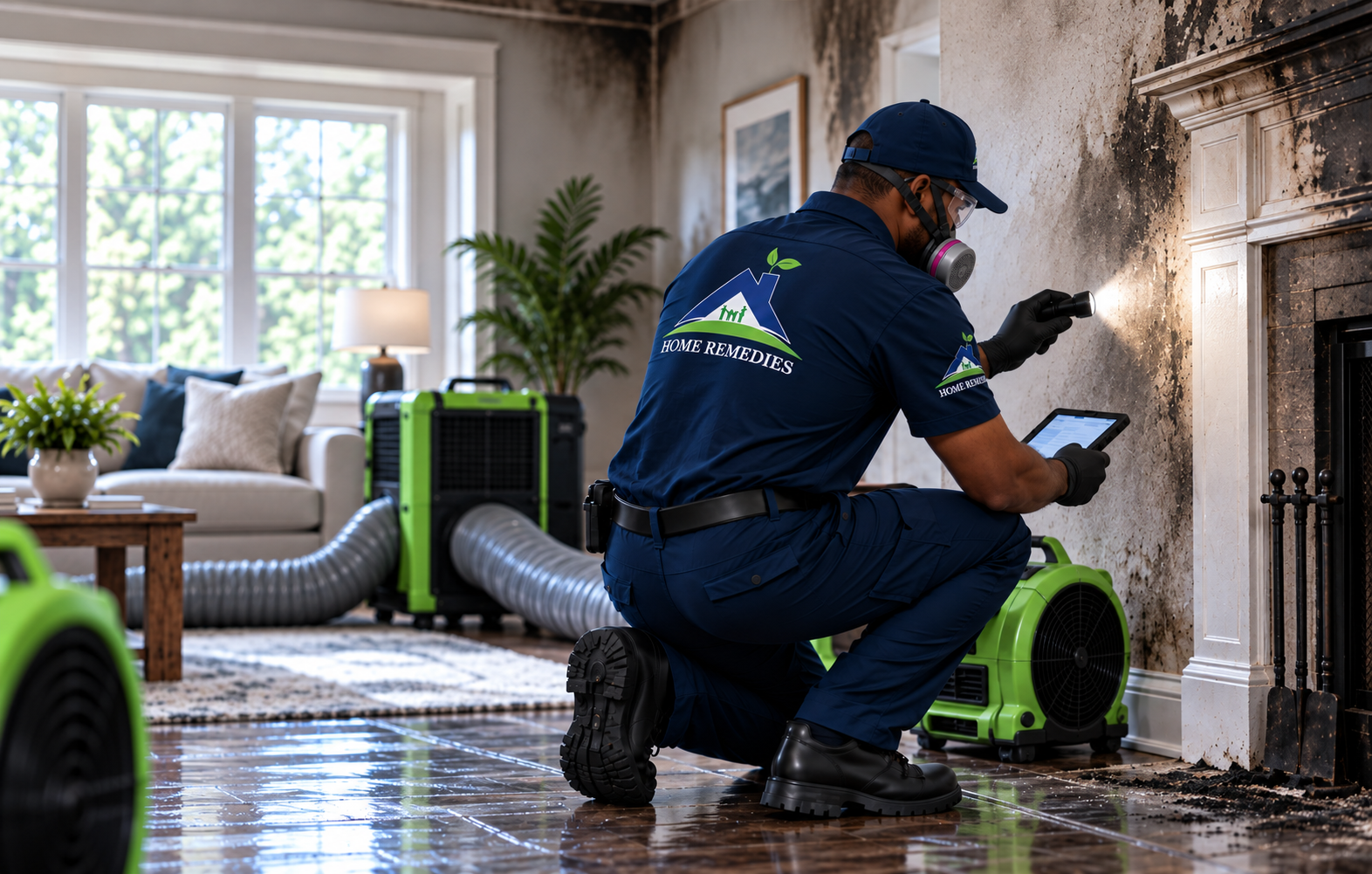
Before cleaning begins, the building is walked and recorded: what burned, how far smoke and soot travelled, where suppression water went, and which assemblies are wet or compromised.
- Visible fire damage and affected structural assemblies
- Smoke and soot pathways, including areas remote from the fire origin
- Suppression water footprint with moisture readings where relevant
- Impacts to finishes and, where relevant, contents
- Photographs and written conditions recorded before work starts
Safety and stabilization
Work areas are protected and access is controlled so residue and debris are not tracked into unaffected parts of the building. Selective demolition is performed only where a material cannot be cleaned or dried in place.
- Work-area protection and floor/pathway coverings
- Containment or isolation of affected areas where appropriate
- Controlled access and debris handling
- Selective demolition of unsalvageable materials, documented before and after
Soot and smoke residue response
Residue is evaluated by surface and material type, because the correct method differs between sealed finishes, porous materials and structural framing.
- Surface-by-surface evaluation of residue type and loading
- HEPA vacuuming and cleaning methods appropriate to each material
- Controlled removal of damaged porous materials that cannot be cleaned
- Detailed cleaning of affected building components and cavities where exposed
Odor management
Odor is treated as a source problem first. Damaged materials holding residue are removed or cleaned before any deodorization step; air management follows removal rather than substituting for it. We do not mask odors.
- Source removal and cleaning before deodorization
- Appropriate deodorization and air management for the affected space
- Re-evaluation after cleaning to confirm the source was addressed
Water and moisture after suppression
Where suppression water affected the building, the water side of the loss is handled the same way as any water loss: extract, map the wet footprint, dry to a documented standard, and record daily progress.
- Extraction of standing and absorbed suppression water
- Moisture mapping of floors, walls, cavities and insulation
- Structural drying with monitored, documented readings
HVAC and air-distribution considerations
Returns, supply runs and equipment can move smoke and soot into rooms that never saw fire. The system is evaluated, and cleaning or treatment is performed when conditions warrant it.
- Evaluation of returns, ducts, coils and equipment for residue
- Cleaning or treatment of affected components when warranted
- Filtration and air management during active work
Reconstruction and return to service
Once the building is clean and dry, restoration work rebuilds what was removed — within the agreed scope — so the property can be returned to use.
- Drywall, insulation, trim and carpentry
- Flooring and finish work
- Paint and final detail cleaning
- Coordination of specialty trades where required
Common conditions we address
- Soot deposits and smoke staining
- Persistent smoke odor
- Suppression-water damage
- Wet insulation, drywall and wood assemblies
- HVAC and duct contamination concerns
- Charred or damaged finishes and materials
- Selective demolition and reconstruction needs
Documentation and insurance support
Photographs, moisture readings and maps where relevant, written scopes, progress records and completion documentation are organized into one package for the property owner and, when applicable, their insurance representative.
Residential, commercial and institutional
Homes, churches, daycares, offices, multifamily and other occupied buildings — the approach is the same, with scheduling, containment and access planned around how the building is used.
Documentation
See documented project work
Photographs from completed and in-progress Home Remedies projects are published in the Project Library.
Questions
Frequently asked
Related
Work that often goes with this
Water Damage Restoration
Extraction, mitigation, structural drying and documentation.
Learn more →Commercial & Institutional Environmental Restoration
Work performed in occupied buildings, on the building's terms.
Learn more →HVAC & Air-Duct Cleaning
Clean the system that moves air through the whole building.
Learn more →Water problem? Start with an inspection.
Tell us what you are seeing and we will investigate the moisture source, document conditions, and put a written scope in your hands.
Active water loss or urgent intrusion? Call rather than submit a form so we can triage it directly.