Property Restoration
Commercial & Institutional Environmental Restoration
Work performed in occupied buildings, on the building's terms.
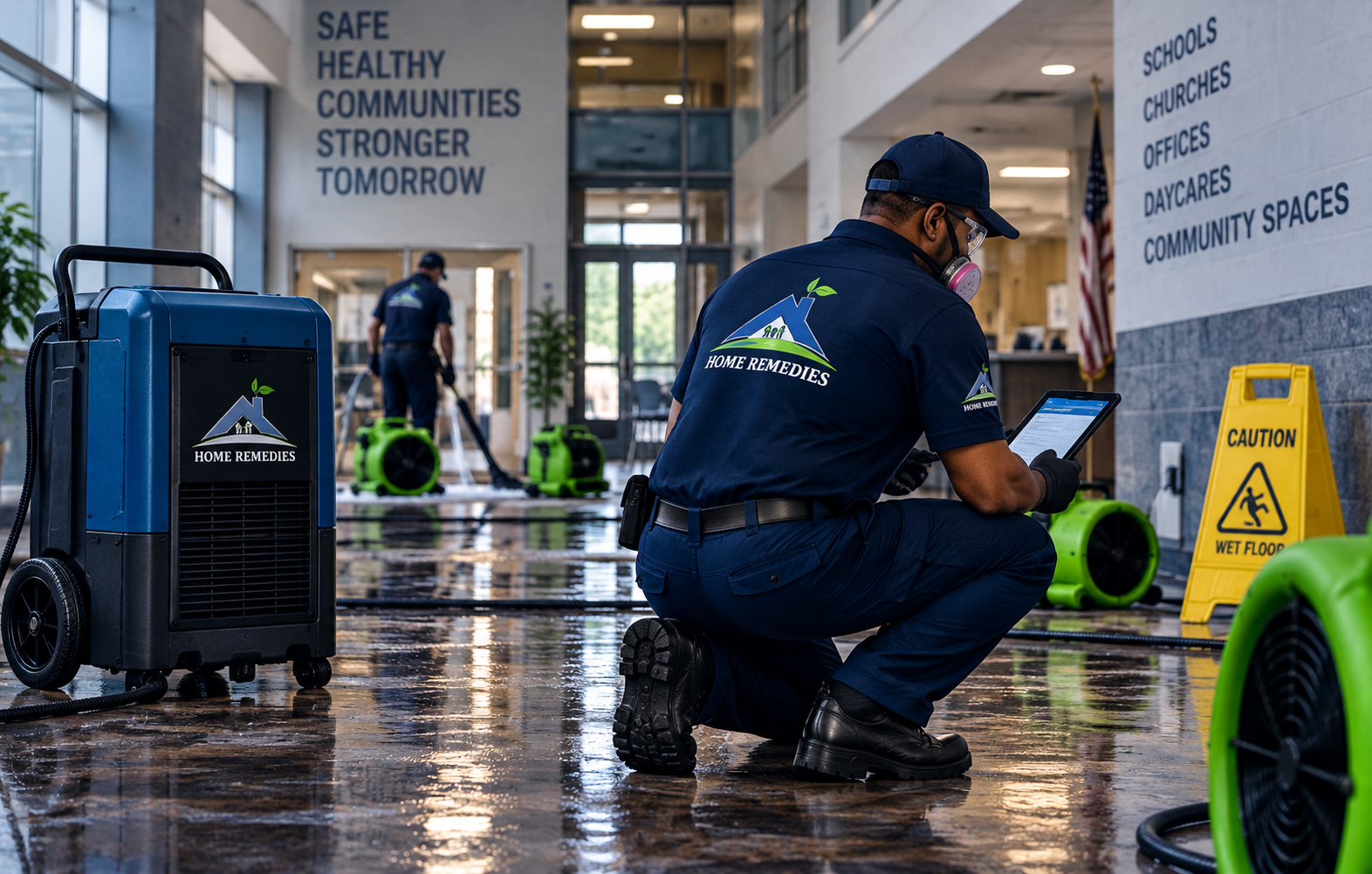
Institutional buildings cannot simply close. A church has services, a daycare has licensing requirements, an assisted-living community has residents who live there, and a school has a calendar. Our commercial work is built around protecting the operating parts of a building while restoration proceeds in the affected parts.
Work-area protection and containment
- Hard and soft containment appropriate to the work and the occupancy
- Isolation of work zones from occupied corridors and egress routes
- Floor, finish and content protection along access paths
- Signage, access control and coordination with facility staff
Environmental controls
- Negative air and HEPA filtration in active work areas
- Dust and particulate control in adjacent occupied spaces
- HVAC isolation coordination so the system does not carry work-area air
- Scheduled monitoring during long-duration projects
Selective demolition, restoration and reconstruction coordination
We perform selective demolition and restoration within our scope and coordinate with reconstruction trades, owner representatives, facility engineers and design professionals so phasing matches the building's operating schedule.
Documentation for institutional owners
Boards, trustees, licensing authorities, lenders and insurance representatives all read the same file. We build that file as the work happens: existing conditions, readings, containment setup, daily progress, scope changes and completion records.
Facility types we serve
- Churches and faith-based facilities
- Daycare and early-childhood centers
- Assisted living and senior care
- Schools and educational buildings
- Offices and professional suites
- Multifamily and property-managed portfolios
- Builders and general contractors
Working in occupied buildings
Most of our commercial and institutional work happens while the building is still in use. That constraint shapes the scope from the beginning rather than being managed around after the fact.
- Containment and negative air sized to keep work areas separated from occupied space
- Hard barriers, pathway protection and controlled entry and exit points
- Dust, noise and odor control planned against the building's actual daily schedule
- Clear signage and defined routes so occupants know what is closed and what is not
Scheduling and phasing
Facilities rarely have the option to close. We phase work by area, by floor or by session so that operations continue, and we set the sequence with the facility's own calendar in front of us.
- Phasing by wing, floor or room group to keep the rest of the building open
- After-hours, weekend and seasonal-break scheduling where that is the least disruptive path
- Staged reopening of completed areas rather than one end-of-project handover
Stakeholder documentation and continuity
Institutional decisions are rarely made by one person. Boards, trustees, facility committees, property managers and carriers each need a version of the same facts. We document once, thoroughly, so every party is working from the same record.
- Photographed conditions, moisture readings and written scope for the project file
- Progress records tied to work areas so a board or committee can follow the sequence
- Completion documentation suitable for facility records and carrier submission
- Continuity planning for the spaces a facility genuinely cannot lose during the work
Documented commercial work
Our church and daycare restoration collections in the Project Library show this approach on real projects — containment and negative air in an operating facility, phased work areas, and before, during and finished conditions for each area.
- Church and institutional restoration collection in the Project Library
- Daycare improvements collection, documented area by area
Documentation
See documented project work
Photographs from completed and in-progress Home Remedies projects are published in the Project Library.
Questions
Frequently asked
Related
Work that often goes with this
Occupancy Ready™ Environmental Cleaning
The cleaning step between construction complete and people moving in.
Learn more →Interim Environmental Management™
A temporary strategy, disclosed as exactly that.
Learn more →Insurance Documentation
Organized reports, readings, photos, scopes and completion records.
Learn more →Water problem? Start with an inspection.
Tell us what you are seeing and we will investigate the moisture source, document conditions, and put a written scope in your hands.
Active water loss or urgent intrusion? Call rather than submit a form so we can triage it directly.